Skip to the content
The initiative is the proposal. RISE is the public work.Read the initiative in bill form →
RISEJTforME

RISE / PUBLIC RESEARCH · 20 SEPTEMBER 2026

Documented connections.
Unanswered questions.

Six legal and judicial professionals. Two source-linked reports. Educational, professional and institutional affiliations—without turning proximity into proof of influence.

The documents, not just the headline

Read the research in full.

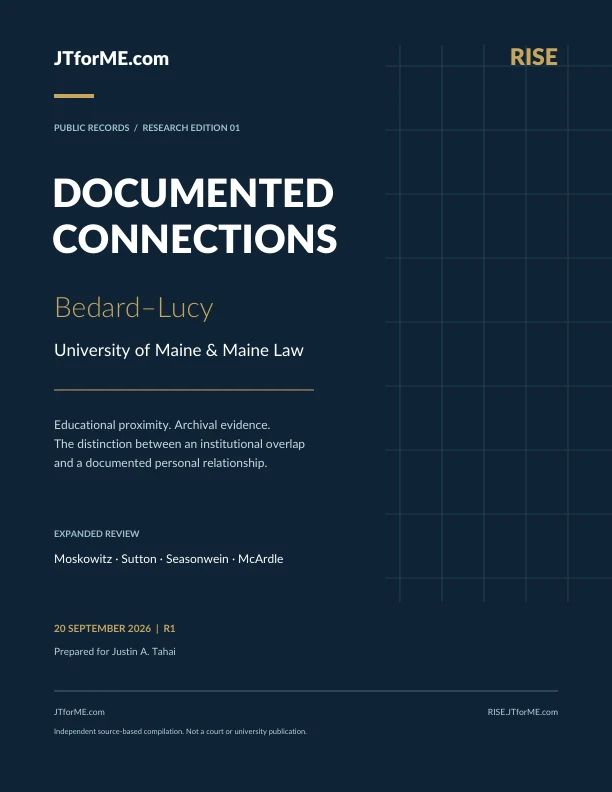
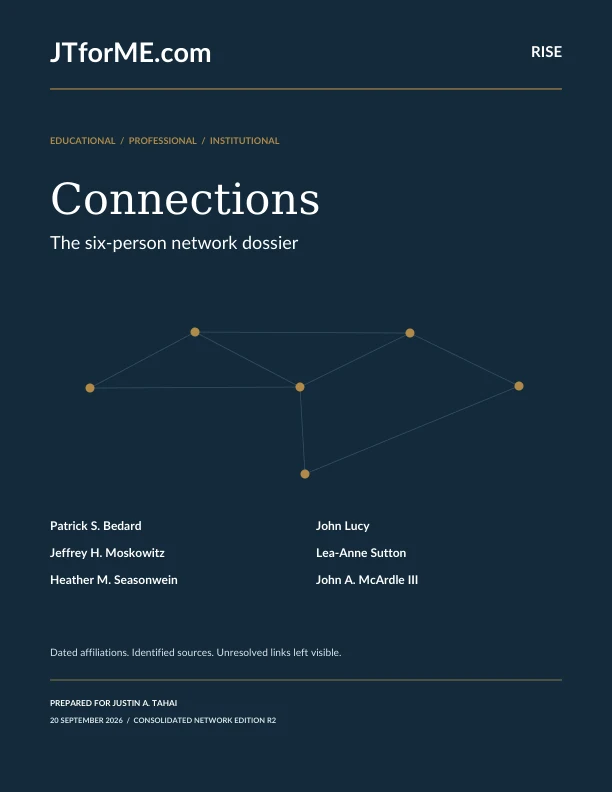
Both supplied PDFs are available unchanged. They are separate research editions with different source registers—not interchangeable copies and not certificates of a relationship.

What this page is: an editorial guide to the two supplied reports, with their original evidence limits. The linked biographies, rosters and institutional publications remain the underlying sources. This release does not claim to have independently reverified every source or filed either report with a court.

Specific propositions. Specific limits.

What the reports support.

Institution documented / overlap inferred

Bedard–Lucy: shared schools, not a proven personal tie.

The reports identify both as University of Maine and Maine Law alumni. Bedard’s published law-school year is 1988; Lucy’s reported year is 1990. A shared 1987–1988 academic year is inferred from ordinary three-year programs, not established by attendance records.

No common class, fraternity, student organization or friendship is established.

R2, pp. 8–14 · R1, pp. 3–8

Reported firm overlap / mixed source quality

Seasonwein–McArdle: a more specific professional lead.

R2 combines a directory entry placing Seasonwein at Kelly, Remmel & Zimmerman in 2018 with the firm’s account of McArdle’s 2007–2023 tenure. Her exact employment period still needs a contemporaneous firm record.

This supports a reported overlap—not a finding of shared casework, supervision, friendship or influence.

R2, pp. 5–7, 16 and 18 · R1, p. 11

Institutional roster / indirect pathway

Common offices and committee roles are different connections.

The reports cite a Biddeford court-office listing for Lucy, Moskowitz, Sutton and Seasonwein. R2 separately traces Sutton → Criminal Process Stakeholders Working Group → Deborah Cashman → Committee on Judicial Conduct → McArdle.

That is a pathway through published roles. It does not identify participants in the review of any particular complaint.

R2, pp. 5–7 and 29 · R1, p. 10

Same-document co-listing

A dated joint publication, with the name limitation intact.

Both reports identify “Heather Seasonwein” and “John A. McArdle” in the signatory list of an October 4, 2018 published letter. The publication omits McArdle’s suffix.

Co-listing is not proof of joint drafting, a private meeting, or a relationship concerning Justin Tahai’s litigation.

R2, pp. 5 and 29 · R1, p. 11
Teaching is not proof of a teacher–student relationship. R2 reports McArdle’s Maine Law Trial Practice teaching through an employer source; the teaching dates and named students remain unverified. The reports do not place all six people in one law-school class. R2, p. 15

Original pages / readable alternatives

A line is an affiliation—not an accusation.

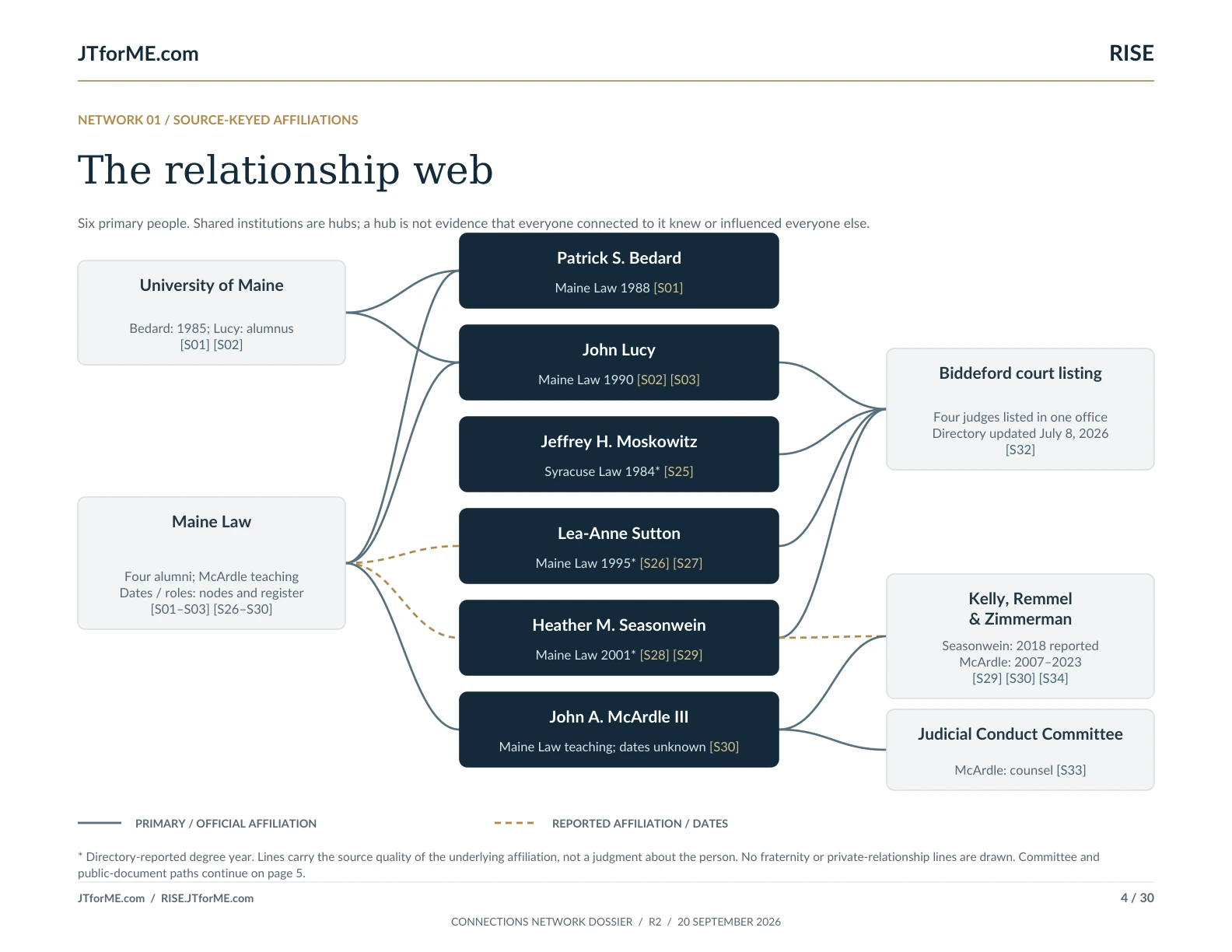
These are page images from the supplied R2 dossier, not a newly inferred network. Open either image at full size or use the page-number link. The text below preserves the distinction between each kind of connection.

R2 page 4 maps six people to universities, a court-office listing, KRZ and the CJC. Solid and dashed lines distinguish source quality; no private-relationship lines are drawn.
R2, page 4: shared institutions are hubs. They do not establish that everyone connected to a hub knew or influenced everyone else. Read the original PDF page.
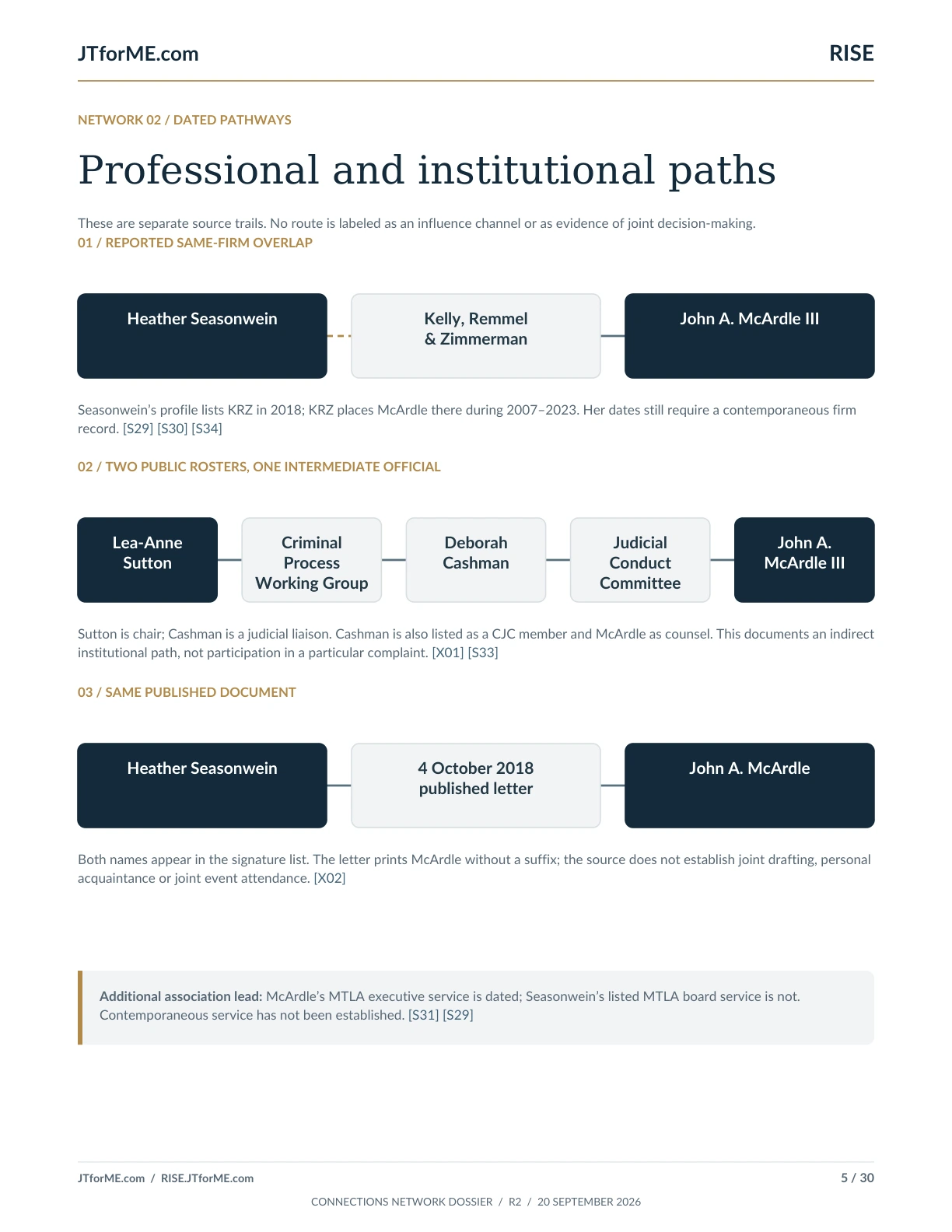
R2 page 5 shows three distinct trails: reported KRZ employment overlap, the Sutton–Cashman–CJC–McArdle institutional path, and the 2018 letter co-listing.
R2, page 5: professional and institutional paths. The source limitations are part of the map. Read the original PDF page.
  • Educational affiliationsUMaine: Bedard and Lucy. Maine Law alumni: Bedard, Lucy, Sutton and Seasonwein. McArdle: a reported teaching role, not alumni status. Moskowitz’s reported law school is Syracuse; McArdle’s is Suffolk. R2, p. 3
  • Reported same-firm overlapSeasonwein → KRZ → McArdle. The reported overlap is 2018; the two employment histories have different source quality. R2, p. 6
  • Indirect institutional connectionSutton → working group → Cashman → CJC → McArdle. Complaint-specific participation remains unknown. R2, p. 29
  • All fifteen pairingsThe full relationship registers include the links not established by the reviewed material. “Not established” is not a claim that the people have never met. R2, pp. 17–18 · R1, pp. 12–13

Do not silently reconcile the source record

Two editions. Visible differences.

R2 retains a different earlier dossier and adds maps. It is not simply a revision of the separately supplied 23-page R1. Use the source IDs from the PDF you are reading.

McArdle’s undergraduate education

R1, page 9, reports UMass Boston, 1984, from a self-presented directory biography. R2, pages 3 and 7, marks the undergraduate detail as unestablished in its retained source set. These are different verification positions. This page does not turn either into registrar confirmation.

The KRZ employment chronology

R1 identifies separate historical firm affiliations and seeks a 2018 roster. R2 adds an employer account of McArdle’s tenure through 2023; Seasonwein’s 2018 history remains directory-sourced. The added primary source strengthens one endpoint, not every possible relationship claim.

Case history versus public affiliations

R1, page 10, uses a supplied transcription of the February 11, 2026 order as a case-history locator. R2 separates procedural relationships from its public affiliation inventory. Signed orders and docket entries—not these summaries—control evidentiary use.

Source codes belong to their own edition

For example, R2’s S30 is the KRZ retirement notice. R1’s McArdle biography is S19. The shared-looking identifiers are not interchangeable. Both reports’ four archival-request templates are labeled as unsent.

The next step is a record, not a stronger adjective

What would answer the open questions?

Exact dates of attendance. Named student-organization records. A contemporaneous 2018 firm roster. Dated teaching assignments and association rosters. Available complaint-specific participation and withdrawal records.

For the school-overlap questions

Seek dated institutional records before treating a likely attendance interval as confirmed. A shared activity needs a separate name-bearing record.

For the professional-overlap questions

Establish employment dates and actual roles. Common employment is not evidence that a particular file, decision or complaint was discussed.

For oversight scrutiny

Identify who actually handled the matter and ask what screening or withdrawal process applied. A roster alone does not identify the decision-makers in a particular docket.

For public corrections

Identify the report, page, exact statement and supporting source. Preserve dated corrections alongside the original editions rather than silently rewriting their provenance.

Publication is not filing. These are research compilations, not authenticated exhibits, a completed grievance, or a motion in a pending appeal. The reports do not themselves establish a disclosure obligation, recusal ground or disciplinary violation. R1, p. 13 · R2, p. 30

Underlying records / source register

Keep a route back to the source.

The following links are source locators cited in the supplied reports. Their presence here is not a claim of a new exhaustive verification. Both PDFs contain the full source registers, retrieval limitations and dated review notes.

How to read evidence labels

Documented: the identified source expressly supports the particular statement; a biography still has the limits of a biography. Reported or source-derived: a directory, supplied transcription or retained research provides the account. Inferred: the conclusion depends on stated assumptions. Unresolved: sufficient material has not been obtained. R1’s complete label key appears on page 2; R2’s map register appears on page 6.

What is not established here?

No verified common fraternity, shared course, friendship, private arrangement, improper influence or complaint-specific conflict is established by the six-person maps. A failed archive search is not evidence of concealment. Stronger relationship evidence would still need a separate connection to the conduct being questioned.

Compiled with generative-AI research, editing and layout assistance, as disclosed in the supplied PDFs. No children’s private records or private residential details are added by this publication package. No one is contacted, and no grievance or court filing is transmitted by using this library.

Public scrutiny is stronger with sources.

Share the research. Keep the context.

You do not have to find all the words yourself. Choose a starting point, edit every word, then decide whether to post. No automatic posting. No account here. Your draft stays in this page until you choose to copy, download or share it.